
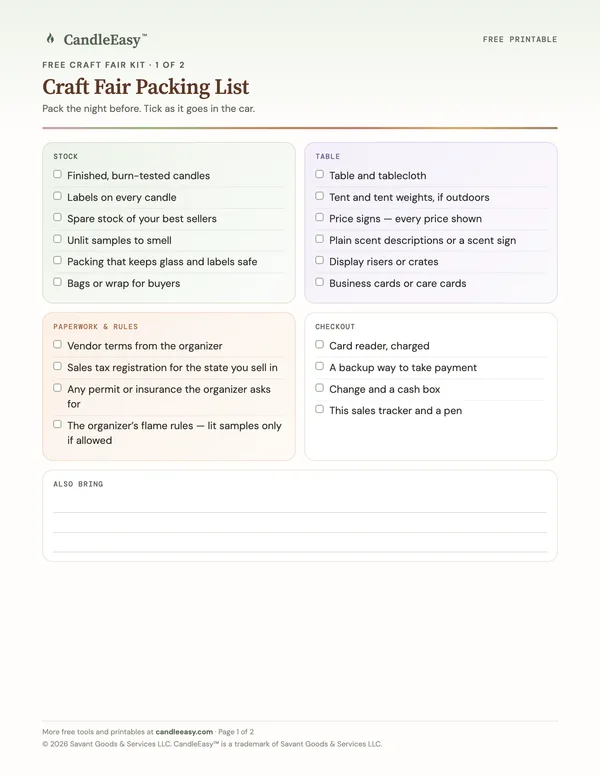
Page 1 — the packing list
Four boxes to tick as things go in the car. Stock: finished, burn-tested candles with labels, spares of your best sellers, unlit samples to smell, and packing that keeps glass and labels safe. Table: tablecloth, tent and weights if you are outdoors, price signs and plain scent descriptions. Paperwork & rules: the organizer’s vendor terms, your sales tax registration for the state you sell in, and the organizer’s flame rules. Checkout: a charged card reader, a backup way to take payment, change, and a pen.
Page 2 — the sales tracker
Write the market, the date and the booth cost, then tally each sale by scent and size. Underneath, note the scents people asked for that you did not have, and the questions customers asked.
At the end of the day, compare what sold with what you expected, and use several events — not one busy hour — to decide what to bring next time.
Before you book
Check the organizer’s rules and your state’s sales tax registration before you pay a booth fee; many states require it even for one-day events. The craft fair guide covers permits, pricing in the booth cost and setting up the table.
Common questions
What should I bring to sell candles at a craft fair?
Finished, burn-tested candles with labels, spares of your best sellers, unlit samples, price signs, scent descriptions, your table setup, a card reader with a backup way to pay, and the organizer’s vendor terms.
Can I burn a candle at my booth?
Only if the organizer and local rules allow it, and only while someone watches it. An unlit sample is often simpler.
Do I need to collect sales tax at a craft fair?
In many states, yes, even for a one-day event. Check the tax agency of the state where the market is held.
Why track sales by scent and size?
It shows what really sells, so you can bring the right stock to the next market instead of guessing.